
Your Local Mortgage Lender
Located in Englewood, Florida
Personalized Mortgage Experience
Ray George offers personalized service and loan options you'll love. We shop multiple lenders to find the best rate and product for you, getting you into your dream home faster.
With wholesale interest rates and cutting-edge technology, we make the mortgage process seamless. Trust the experts who focus solely on mortgages. Support your local community and experience elite client service.
Let us help you achieve your homeownership dreams!
The Home Loan Process
Mortgage Pre-Approval
Get pre-approved from one of our Loan Officers to see how much you can afford.
Review The Process
Work with our team to find your next home you would like to move into
Loan Application
Complete your home loan application to get the lending process started.
Don't take my word for it
Mortgage Programs
Experience the best mortgage experience located in Englewood, Florida.
Home Loan Options
Our experienced mortgage advisors will walk you through the best mortgage loan program that will fit your specific scenario.
Conventional Home Loans.
FHA Home Loans.
USDA Home Loans.
VA Home Loans.
Frequently Asked Questions
How often can I refinance my mortgage?
There is no limit to the number of times you can refinance. However, you must qualify every time you apply and there will be costs associated with closing the loan each time.
Can I buy a home if I do not have money for a down payment?
Yes! There are a number of bond programs that offer low or no down payment financing options.
How do I know which mortgage is right for me?
The key to choosing the right mortgage is to understand the range of options and features available to you, as well as your budget, circumstances, and goals. Our licensed mortgage professionals are here to help you navigate that process. The more you know, the more comfortable and confident you will be choosing the best option for you and your family.
How long will the loan process take?
The Truth in Lending Act (TILA) does not permit a lender to close a loan until at least seven (7) business days have passed from the date your application was received. A typical home loan takes 30 days, as a number of third-party services such as appraisals, title work, and credit are required in conjunction with the mortgage process. Once you familiarize your Loan Officer with the details of your specific loan scenario, they will be able to provide you with a more specific timeline.
Will I qualify for a home loan?
The only way to find out is to speak with a qualified mortgage professional. Our Loan Officers have helped numerous clients who didn’t know if they could qualify to become home owners. We take the time to understand your financial situation and long-term financial goals, and then match you with the loan program that best fits your needs. Your approval for a loan may also largely depend on the price of the home you are financing. Getting pre-qualified prior to beginning your home search can give you an idea of what you may be able to afford.
Why do people refinance their mortgages?
Homeowners typically refinance to save money, either by obtaining a lower interest rate or by reducing the term of their loan. Refinancing is also a way to convert an adjustable loan to a fixed loan or to consolidate debts.
How much money will I have to pay upfront to buy a home?
This question does not have a simple, one-size-fits-all answer. The exact amount will depend on the price of the home you buy as well the type of mortgage financing you choose. Depending on your loan program, your down payment could be as much as 20% of the home’s price or as little as 3%, while some loans require no down payment at all.
Can I get a mortgage after bankruptcy?
You may still qualify for a home loan even if you have experienced a bankruptcy. The best way to find out if you qualify is to talk with a Loan Officer to discuss your options. Be sure to bring all paperwork regarding your bankruptcy so your Loan Officer can find the program that best fits your situation.
Should I lock my interest rate now, or wait until we are closer to our closing?
Interest rates fluctuate all day, every day. If an interest rate is good, it may be in your best interest to lock now. If you wait, you run the risk of an increase in rates later. If you are concerned that rates may go down after you lock, contact your Loan Officer to discuss your options. Some programs allow you to lock for an extended period and choose to lower your rate should a better one become available.
Most Recent Blog Updates
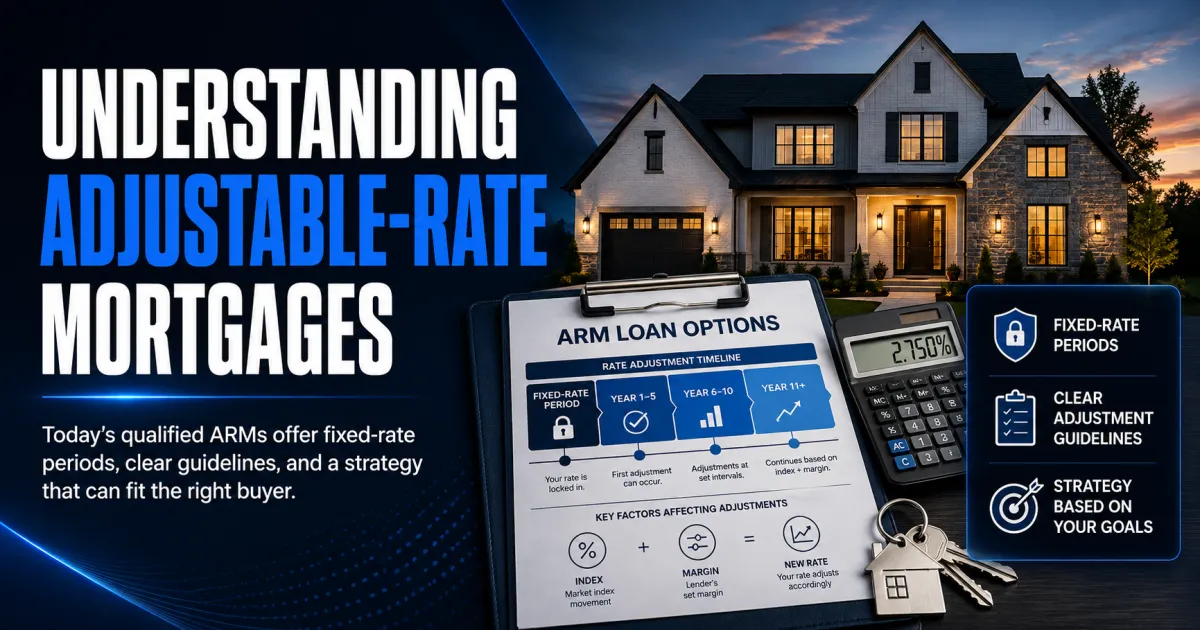
Adjustable Rate Mortgages Are Not What They Were in 2008 and Here Is What Buyers Should Know Now
The Word That Makes Buyers Nervous and Why the Reaction May Be Outdated
When most buyers hear the term adjustable-rate mortgage the immediate association is 2008. The housing crisis. Loans that reset to payments borrowers could not afford. Foreclosures. The entire narrative around what went wrong in the last major housing collapse.
That association is understandable. It is also increasingly outdated when applied to the qualified adjustable-rate mortgage products available in today's market.
What Is Different About Today's ARM Products
The ARMs that contributed to the 2008 crisis were in many cases loosely underwritten products with minimal qualification standards and aggressive reset terms that borrowers did not fully understand. The regulatory environment that followed produced a fundamentally different product category.
Today's qualified adjustable-rate mortgages typically include a fixed-rate period during which the rate does not change at all. A five-year ARM holds the rate steady for five years before any adjustment occurs. A seven-year ARM holds for seven years. A ten-year ARM for ten. The adjustment that eventually occurs is governed by clear caps on how much the rate can move at each adjustment period and over the life of the loan. And the qualification requirements are stricter than they were before the crisis.
As Ray George explains these are not the same products that drove the problems of 2008. They are well-regulated clearly structured loan options that make financial sense for a specific subset of buyers depending on their situation.
When an ARM Actually Makes Sense
The strategic case for an ARM is built around the borrower's timeline and financial goals rather than simply chasing a lower initial rate.
A buyer who knows with reasonable confidence that they will be in the home for five to seven years before selling or refinancing is in a very different position than a buyer purchasing a forever home with no anticipated sale or payoff for twenty-five years. For the first buyer a seven-year ARM provides a lower rate during the entire period they actually plan to own the property. The adjustment that would eventually occur after year seven is largely irrelevant to their financial outcome because they will not be holding the loan when it happens.
A buyer who anticipates significant income growth or a financial event within the next several years that would allow them to refinance or pay down the loan substantially is another profile where the ARM math can work in their favor.
The question is not whether ARMs are good or bad in the abstract. It is whether the structure of a specific ARM product aligns with the specific plan of the specific borrower sitting across the table.
The Broader Principle Worth Understanding
A mortgage should fit your plan rather than simply responding to today's market conditions. Rate shopping in isolation without a clear understanding of how long you will hold the loan, what your financial picture looks like over the next five to ten years, and what your goals are for the property produces loan decisions that optimize for one variable while ignoring the others that actually determine the outcome.
Ray George works with buyers to understand the strategy behind the loan rather than just the product itself. If you are navigating the affordability challenges of the current market and want to understand whether an ARM or another structure makes sense for your specific situation reach out to Ray George to have that conversation.
Sources
ConsumerFinancialProtectionBureau.gov
FannieMae.com
MortgageNewsDaily.com
Investopedia.com
FederalReserve.gov

Mortgage Calculator
See your total mortgage payments using the tool below.
| Year | Interest | Principal | Balance |
|---|

State Licenses
FL #LO131416
AL #1998987
IN #68060
TX #1998987
